Overview
This digital archive provides scholarly access to Harris's List of Covent Garden Ladies, an annual directory of London sex workers published between 1760 and 1794 (the earliest surviving edition is from 1761).
Through digital facsimiles, structured data extraction, and critical analysis, this project aims to recover the histories of marginalized women in Georgian London while maintaining awareness of the problematic male perspective inherent in the source material.
Harris's List Digital Archive is in active development. We welcome feedback, corrections, and collaboration from scholars, students, and the public.
Methodology
Data Extraction
Biographical data is extracted from digitized editions using computationally-assisted methods. Each entry is processed to capture:
- Physical descriptions (age, height, hair/eye colour, complexion)
- Addresses and geographic locations
- Professional information (experience, pricing)
- Social relationships and networks
- Skills and accomplishments
All extracted data preserves original language alongside normalized values, allowing researchers to engage with both the historical text and structured analysis.
Critical Framework
This project approaches Harris's List through multiple critical lenses:
- Social History: Understanding the economic, class, and social contexts that shaped sex work in Georgian London
- Historical Materialism: Analyzing the economic relationships and material conditions of the period
- Digital Humanities: Using computational methods to identify patterns and connections across the publication history from 1760 to 1794
- Women's History: Building on decades of scholarship that has worked to recover women's agency and lived experiences, particularly the contributions of feminist historians who have transformed our understanding of women's lives in the past
- Close reading: Understanding the textual duality of Harris's List as both Gebrauchstext and fictionalised text
Sources and Citations
Harris's List was published (with little irregularity) annually between 1760 and 1794. Of these editions, 18 are known to have survived (the earliest from 1761).
Primary sources are held by institutions including:
- Yale University Library
- Bibliothèque nationale de France
- Bibliothèque Mazarine
- Staats- und Universitätsbibliothek Hamburg
- Bayerische Staatsbibliothek
- National Library of Sweden
- Universitätsbibliothek Kiel
Publication of Harris's List ceased in 1795, when its last publishers, John and James Roach, and John Aitkin, were prosecuted for obscenity. The Criminal Registers of Prisoners in Middlesex and the City, which are held by The National Archives (UK), provide details of James Roach's prosecution and sentencing:
James Roach [brought to] Newgate [on] Febry. 9[, 1795 by] Court KB. [for the crime of] Publishing Harris's List of the Covent Garden Ladies. [Sentenced to] 12 Calendar months Newgate and give Security for 5 yrs himself in 100 and 2 Suretys in 50 each. Pardoned the 10 June 1795 to recognize to the satisfactn. of the Justices of the Cot of KB not to transgress agst the Law's & for of 7 yrs. [He was] discharged.
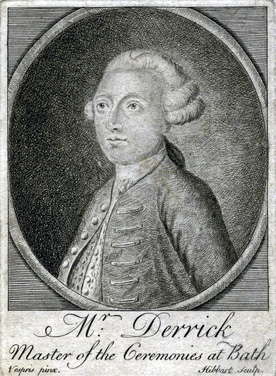
Samuel Derrick (1724–1769), Master of Ceremonies at Bath, attributed as the original author
Ethical Considerations
Harris's List presents significant ethical challenges for modern scholarship. The texts:
- Were written entirely from the male perspective for male consumption
- Objectify and commodify women's bodies
- May include coerced or trafficked individuals, young adolescents, and references to sexual violence
- Reflect metropolitan bias as well as period racism, classism, misogyny, and homophobia
Our approach seeks to:
- Acknowledge these limitations explicitly
- Avoid reproducing exploitative framing in our analysis
- Center questions of women's agency and lived experience where possible
- Situate sex work within its historical context
- Provide tools for critical engagement rather than uncritical consumption
- Contextualize terminology within its historical and cultural framework
Research Opportunities
This digital archive enables investigation of:
- Geographic patterns of sex work across London neighborhoods
- Economic networks and pricing structures
- Changes in descriptive language and categorization over time
- Individual mobility and career trajectories across editions
- Relationships between sex workers and "keepers" (patrons)
- Representation of race, nationality, and origin
- The intersection of sex work with other professions and skills
Acknowledgments
This project builds on decades of scholarship on Harris's List and Georgian London. Matthew Sangster's outstanding Romantic London project provided critical inspiration for and contributed data to this archive.
Historical maps: An Exact Survey of the City's of London and Westminster ye Borough of Southwark and the Country Near Ten Miles Round Begun in 1741 & Ending in 1745 by John Rocque Land Surveyor & Engrav'd by Richard Parr (David Rumsey Map Collection); Richard Horwood’s PLAN of the Cities of LONDON and WESTMINSTER the Borough of SOUTHWARK, and PARTS adjoining Shewing every HOUSE (1792-9) (British Library Crace Collection Maps.Crace.V; © The British Library Board, HUS 050.); William Faden’s revision of Horwood’s Plan (1819) (British Library Cartographic Items Maps 33.e.24.; © The British Library Board, HUS 050.).
Historical places: Tim Hitchcock, Robert Shoemaker, Sharon Howard, Jamie McLaughlin, Patrick Mannix, Museum of London Archaeology (MOLA), et al. Locating London’s Past [Data files]. Available at: https://www.dhi.ac.uk/data/locatinglondon (Accessed: 10th February 2026).
Cover image: Richard Newton's Progress of a Woman of Pleasure, hand-coloured etching, on wove, 53.5 x 74.0 cm. William Holland, 20 April, 1796. Bonhams Books & Manuscripts, Wikimedia Commons.
Digital facsimiles of the source editions of Harris's List of Covent-Garden Ladies are provided by institutions committed to open access to cultural heritage materials.
Further Reading
- Delinger, Elizabeth Campbell. “The Garment and the Man: Masculine Desire in ‘Harris’s List of Covent-Garden Ladies’ 1764 –1793”. Journal of the History of Sexuality, Vol. 11, No. 3 (2002): 357–394.
- Freeman, Janet Ing. “Jack Harris and ‘Honest Ranger’: The Publication and Prosecution of Harris’s List of Covent-Garden Ladies, 1760–95”. The Library, 7th series, vol. 13, no. 4 (December 2012): 423–456.
- Killoran, Francesca. ‘Wicked, nasty, filthy, bawdy, and obscene’: the Development of Harris’s List of Covent-Garden Ladies from 1760 - 1794. (MPhil thesis, University of York, 2024)
- Lowe, Polly. “The Body as Property and the Moral Limits of the Market: Attitudes towards the Sex Trade in Eighteenth-Century England.” Slavery & Abolition, 47(1) (2026): 36–59.
- Parsons, Nicola, and Amelia Dale. “Harris’s List of Covent-Garden Ladies (1760–1794): New Copies and New Evidence regarding its History”. The Library, 7th series, vol. 23, no. 4 (December 2022): 458–488.
- Peakman, Julie. Mighty Lewd Books: The Development of Pornography in Eighteenth-Century England. Houndmills, Basingstoke: Palgrave Macmillan, 2003.
- Rubenhold, Hallie. The Covent Garden Ladies. Cambridge: Black Swan, 2020 [1st ed. 2005].
- Sangster, Matthew. “Harris's List of Covent-Garden Ladies”. Romantic London, 2015- . https://www.romanticlondon.org/harris-list-1788/
Technical Details
This website uses:
- Mirador 3 for IIIF image viewing and comparison
- DataTables for searchable, sortable data presentation
- Leaflet for interactive map display
- D3 for network visualizations
- LLMs for computationally-assisted data extraction and voice narration
Contact
For questions, corrections, or collaboration inquiries, please contact:
Harris's List Digital Archive
Alexander Huber, Editor
- Web: https://users.ox.ac.uk/~bodl0153/
- E-mail: help@prisms.digital
- Bluesky: @c18ah.bsky.social
#HarrissListDigitalArchive - Mastodon: https://hcommons.social/@c18ah
#HarrissListDigitalArchive - X: @C18AH
#HarrissListDigitalArchive